By Hamed Kenani
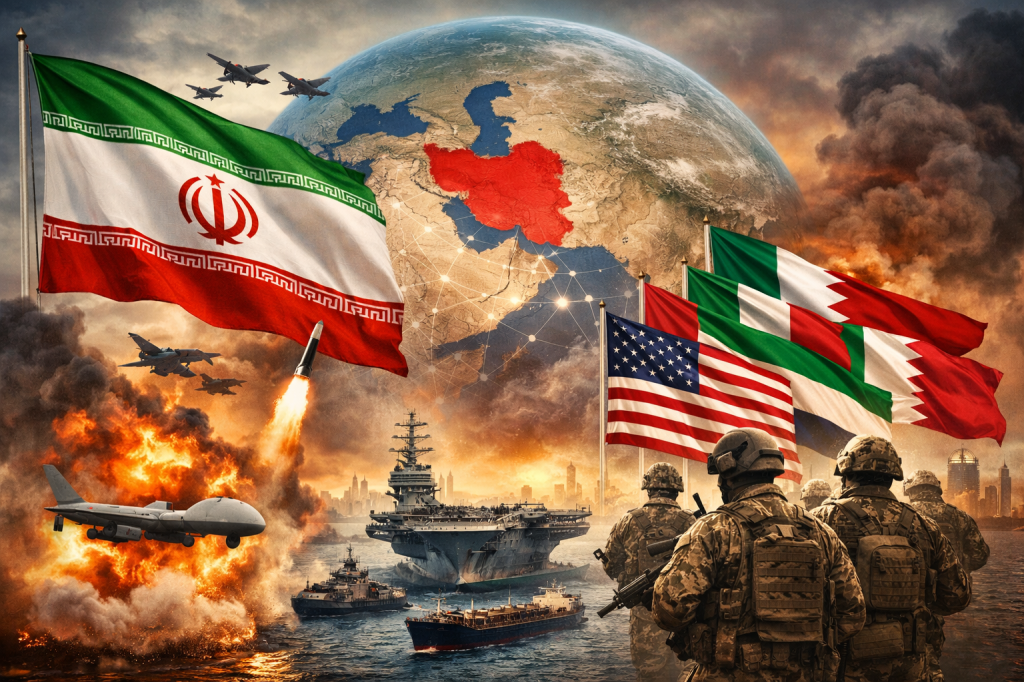
Following the 2015 Iranian nuclear agreement, Iran entered a new phase of openness and international monitoring, as its nuclear file moved from the sanctions list to a defined international supervisory framework. However, recent events, including attacks on Gulf states and the Hashemite Kingdom of Jordan, have brought the Iranian file back into the spotlight of international security concerns, reflecting escalating tensions in the region and the potential formation of international alliances to counter Iran’s increasing threats to regional and global security.
In 2015, after the signing of the Iranian nuclear agreement officially known as the Joint Comprehensive Plan of Action (JCPOA), Iran entered a new phase in its relations with the international community regarding its nuclear program. The agreement between Iran and the six major powers (the United States, the United Kingdom, France, Russia, China, and Germany) aimed to limit the nuclear program in exchange for lifting economic sanctions. Prior to the agreement, Iran’s nuclear program was a subject of the UN Security Council due to previous resolutions, such as 1696, 1737, and 1747, which imposed restrictions on Iran because of its nuclear activities.
With the signing of the agreement, the Security Council adopted Resolution 2231, which ended some previous restrictive measures, lifted outstanding issues referred to the Council, and provided the agreement with a form of international legitimacy, under the supervision of International Atomic Energy Agency inspectors. With this resolution, Iran was no longer subject to direct Security Council monitoring as before; pending matters were suspended or lifted, and its nuclear program became subject only to the agreement and international oversight.
In summary, Iran did not withdraw its nuclear file unilaterally; rather, the status of the file in the Security Council was amended under Resolution 2231, moving Iran’s nuclear program from the sanctions list to a new international supervisory framework ensuring Iran’s commitments under the nuclear deal.
Today, following Iran’s blatant aggression against the countries of the Gulf Cooperation Council, targeting industrial and civilian infrastructure, in addition to the ongoing attacks on the State of Israel and the Hashemite Kingdom of Jordan, the Iranian issue has returned to the Security Council. On March 11, 2026, the Council adopted Resolution 2817, which aims to address the escalation of violence in the Arabian Gulf region, particularly between Iran, the Gulf Cooperation Council countries, and Jordan.
The Kingdom of Bahrain presented this draft on behalf of the GCC countries—which include Saudi Arabia, the UAE, Qatar, Kuwait, and Oman—alongside Jordan. The resolution was adopted with 13 votes in favor, while Russia and China abstained from voting, and no direct opposition was recorded.
The resolution strongly condemns Iranian attacks targeting residential areas and infrastructure in the Arabian Gulf countries and Jordan, considering them violations of international law and serious threats to international peace and security. It calls for an immediate and unconditional cessation of these attacks, while reaffirming support for the sovereignty, political independence, and territorial integrity of the affected countries. The resolution also condemns any threats or actions that could impede international navigation, such as Iran’s threats to close the Strait of Hormuz, as a threat to international peace and security.
The GCC countries and Jordan welcomed the resolution, considering it a reflection of a unified international stance in support of sovereignty and regional security. The Arab League and the Organization of Islamic Cooperation also expressed approval. Despite Russia and China’s abstention, the resolution received broad support from Security Council members, indicating unprecedented international mobilization to confront attacks threatening regional stability and security.
Reviewing international actions and alliances, it is clear that countries that violate other states’ sovereignty and threaten international security and stability often face sanctions and military interventions. History illustrates this clearly: the international community successfully dismantled the former Yugoslavia, mobilized forces to liberate Kuwait after Iraq’s invasion in 1990, overthrew the Taliban regime in Afghanistan, removed the Iraqi regime in 2003, and toppled Libya’s regime in 2011. These experiences indicate that the international community deals decisively with states that pose threats to regional and global security.
Regarding Iran, it has once again emerged as a leading state considered a source of threat to both regional and international security, making it a candidate for confrontation by strong international alliances. Previous interventions, such as in Kuwait, Yugoslavia, Afghanistan, and Libya, were driven by direct violations of state sovereignty, violent internal regimes, or specific incidents like the Lockerbie bombing.
Any potential international alliance against Iran would differ in scale and intensity. Its motivations would not only be political and legal, relating to international law and the UN Charter, but also economic. The GCC states form a major global economic hub relied upon for energy, fuel, and investment; thus, any threat to this hub or its infrastructure would have a broad global impact.
Iran’s recent actions—such as targeting fuel depots and oil tankers, and threatening the Strait of Hormuz—will unite the international community against it. This is likely to lead to a broad and powerful international alliance, stronger than previous coalitions, aimed at mitigating Iran’s threats and safeguarding regional and global security and stability.
Domestically, the era of a centralized authoritarian state over non-Persian regions is expected to end, with Iran potentially returning to a structure reminiscent of the Qajar era, which granted internal autonomy to non-Persian regions. To identify these areas, one can observe Iran’s map, noting peripheral regions labeled after their ethnic populations followed by “-stan,” such as Arabistan (now Khuzestan), Kurdistan, Baluchistan, and Luristan.
This transformation implies that the Persian population would have to accept the rights of other ethnic groups, recognize their national and political rights, and share sovereignty and resources with them. However, given the nationalist biases of most authoritarian opposition currents, whether royalist or leftist, such a project would face significant challenges, increasing the likelihood of Iran’s state disintegration. This could provide non-Persian populations, particularly the Ahwazi people in southern Iran, the opportunity to regain independence after more than a century of Persian control.
Conversely, Persian influence in Iran’s historic interior regions—long dominated by Persians alongside Turkish rulers—may decline, while resources from peripheral regions such as Ahwaz, Kurdistan, Baluchistan, Azerbaijan, and Turkmen Sahra are concentrated in the Persian center, now enriched with infrastructure and factories. Isfahan could become the future capital of a Persian-only Iran, with the central government’s control limited to these areas.
All these factors indicate that the region is heading toward major international transformations, similar to the liberation of Kuwait, where the Arabian Gulf states may seek to dismantle a large Persian-nationalist, sectarian Iranian state reliant on regional expansion, provocation, and support for terrorism, while violating neighboring states’ sovereignty to achieve national and sectarian objectives. Such conduct constitutes violations of international law and humanitarian principles, and a direct threat to international and regional peace and security.
With escalating Iranian threats to the security of the Arabian Gulf states and Jordan, the region appears poised for broad strategic transformations. It is likely that future developments will involve unified international measures—including political, economic, and potentially military actions—alongside a domestic redistribution of power within Iran itself, potentially paving the way for a reshaping of the region’s geopolitics and the emergence of new dynamics for the rights of non-Persian peoples.
 مركز دراسات عربستان الأحواز- حامد الكناني
تشرفنا بزيارتكم ونتمنى دائما أن ننول رضاكم.